This page contains my notes from:
Index for anything and everything:
Chapter 1: World War 2
Chapter 2: Running and Stuff
Chapter 3: Random Stuff
Interesting Links
-
Chapter 1: Random Stuff
Basics of war
- MV Wilhelm Gustloff was a German military transport ship, sunk on 30 January 1945 by Soviet submarine S-13
in the Baltic Sea while evacuating civilians and military personnel.
- ORP Orzeł was an Orzeł class submarine of the Polish Navy that served during World War II. Orzeł entered, in September 1939, the harbour of neutral Estonia. The Estonian authorities tried to intern the submarine, under pressure from Germany and the Soviet Union, but it escaped.
- The Miracle on the Vistula: 1920 war between Poland and Soviets.
- Stalin's purge of 1930s.
- Operation Barabarossa: Hitler attacks the Soviets.
- Soviet invasion of Poland: 16 days after Hitler invaded Poland from the west, Stalin invaded Poland from the east. They carved out Poland into two parts as their own spheres of influence. It stayed this way until Hitler invaded the soviets under the Operation Barbarossa.
- Hitler's rescue of Mussolini.
- Lend-Lease Act - The Lend-Lease Act was signed into law on March 11, 1941, and ended on September 20, 1945. A total of $50.1 billion (equivalent to $690 billion in 2024 when accounting for inflation) worth of supplies was shipped, or 17% of the total war expenditures of the U.S. In all, $31.4 billion went to the United Kingdom, $11.3 billion to the Soviet Union, $3.2 billion to France, $1.6 billion to China, and the remaining $2.6 billion to other Allies. Reverse Lend-Lease was the supply of equipment and services to the United States. Nearly $8 billion (equivalent to $124 billion today) worth of war material was provided to U.S. forces by its allies, 90% of this sum coming from the British Commonwealth Empire - mostly India and Australia.
- Warsaw’s sewers connect the city to its brutal past: Note From Poland.
- ORP Orzeł was an Orzeł class submarine of the Polish Navy that served during World War II. Orzeł entered, in September 1939, the harbour of neutral Estonia. The Estonian authorities tried to intern the submarine, under pressure from Germany and the Soviet Union, but it escaped.
- The Miracle on the Vistula: 1920 war between Poland and Soviets.
- Stalin's purge of 1930s.
- Operation Barabarossa: Hitler attacks the Soviets.
- Soviet invasion of Poland: 16 days after Hitler invaded Poland from the west, Stalin invaded Poland from the east. They carved out Poland into two parts as their own spheres of influence. It stayed this way until Hitler invaded the soviets under the Operation Barbarossa.
- Hitler's rescue of Mussolini.
- Lend-Lease Act - The Lend-Lease Act was signed into law on March 11, 1941, and ended on September 20, 1945. A total of $50.1 billion (equivalent to $690 billion in 2024 when accounting for inflation) worth of supplies was shipped, or 17% of the total war expenditures of the U.S. In all, $31.4 billion went to the United Kingdom, $11.3 billion to the Soviet Union, $3.2 billion to France, $1.6 billion to China, and the remaining $2.6 billion to other Allies. Reverse Lend-Lease was the supply of equipment and services to the United States. Nearly $8 billion (equivalent to $124 billion today) worth of war material was provided to U.S. forces by its allies, 90% of this sum coming from the British Commonwealth Empire - mostly India and Australia.
- Warsaw’s sewers connect the city to its brutal past: Note From Poland.
Chapter 2: Running and Stuff
Concurrent Training: A Meta-Analysis Examining Interference of Aerobic and Resistance Exercises
- Your hips are the engine. Your legs are the wheels.
- Link to paper.
- Hip mobility.
- Garmin Human Performance Lab
- Exercise-associated Muscle Cramps in Runners: A Review
- Link to paper.
- Hip mobility.
- Garmin Human Performance Lab
- Exercise-associated Muscle Cramps in Runners: A Review
Welcome to Cramp Central
What is physically happening
- Exercise-Associated Muscle Cramps (EAMCs) are largely believed to be caused by altered neuromuscular control. When a muscle is severely fatigued, the electrical signals misfire: the receptors that tell the muscle to contract (muscle spindles) become hyperactive, while the receptors that tell it to relax (Golgi tendon organs) become depressed. The muscle gets stuck in a fully contracted loop.
- Passive stretching physically pulls on the tendon. This sudden, applied tension artificially stimulates those under-active Golgi tendon organs. Once stimulated, they send a powerful inhibitory signal back to the spinal cord, forcing the motor neurons to stop firing. This mechanism is called autogenic inhibition—you are literally short-circuiting the cramp.
What to do when you arrive at Cramp Central
- Stop immediately. Do not try to run through it. Continuing to push a cramping muscle forces the misfiring neurons to keep firing, making the cramp lock up harder.
- Execute a straight leg stretch. Step your cramping leg back, keep the heel glued to the ground, lock the knee straight, and lean your hips forward. Or. Stand with the ball of your foot on a curb or rock, and drop your heel straight down toward the street while keeping your leg straight.
Show Image 
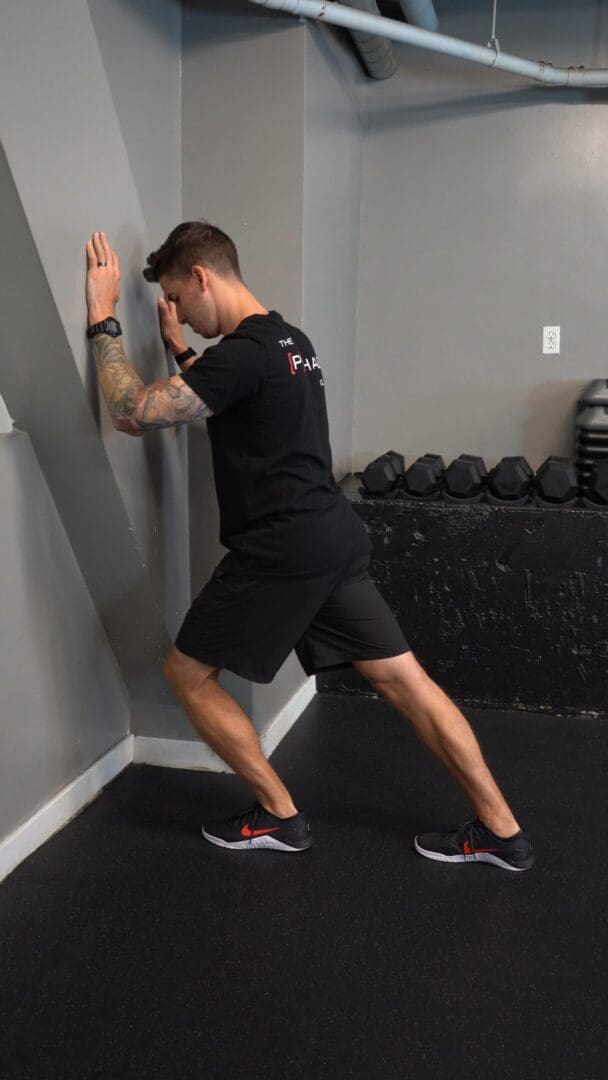
- Walk for 1 to 2 minutes to allow normal blood flow and neurological signaling to resume before easing back into a jog.
How to (possibly) prevent catching a one-way train to Cramp Central
- Try changing your running gait? A heavy mid or forefoot strike forces the calf and Achilles tendon to act as the primary impact absorbers on every single footfall. Landing closer to a flat midfoot (or allowing your heel to lightly kiss the ground) transfers impact forces up toward your knees and hips.
- Drive with the Glutes, Don't "Push Off" the Toes. Focus on driving forward via hip-extension - letting our glutes pull the leg back rather than kicking off the ground with your foot.
Chapter 3: Random Stuff
Concurrent Training: A Meta-Analysis Examining Interference of Aerobic and Resistance Exercises